Triathletes are made in winter | 10 top swimming tips
3rd Dec 2025 | Written by Pamela Sneddon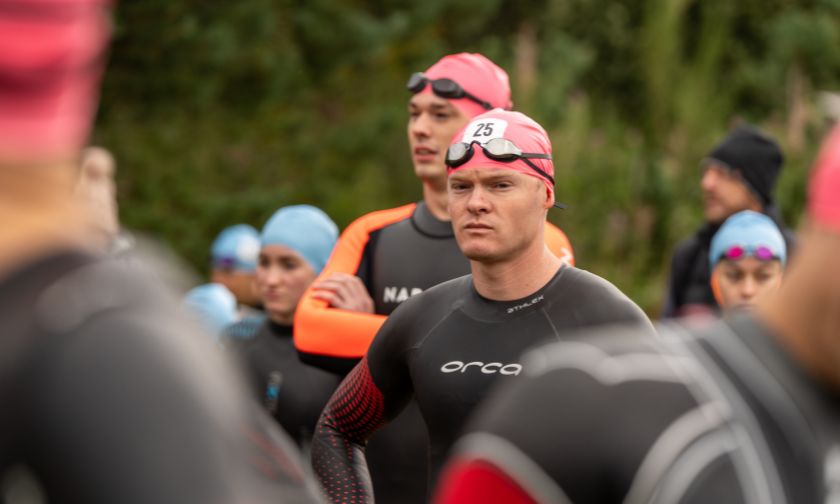
1. Focus on Technique, Not Just Fitness
Triathlon swimming is about efficiency – you want to come out of the water fresh for the bike.
Key technique points:
- Keep a long, streamlined body this will reduce drag.
- Rotate your head, torso and hips together with each stroke – imagine a skewer
- Enter the water fingertips first, extend forward, initiate catch by bending elbow, pull straight-back path keeping elbow high
Think: “Reach, roll, pull.”
Drill:
- Do catch-up drills (one arm waits in front until the other finishes) to improve rhythm and alignment.
- Do kickboard pull to help rotation – put kickboard between thighs, touch kickboard with hand as it exits the water at end of stroke.
2. Master Bilateral Breathing
Breathing on both sides balances your stroke and helps in choppy open water.
- Exhale when your face is in the water, inhale in when your face is out of the water
- Practice breathing every 3 strokes during training.
- This helps you adapt if waves or sun make one side difficult to breathe on during a race.
Drill:
- 1 length breathing to right, 1 length breathing every 3 strokes (alternate right and left breathing), 1 length breathing to left, 1 length breathing every 3 strokes
3. Build Endurance Gradually
You’ll need to swim smoothly for 750m-1500m (sprint or Olympic distance).
Focus on aerobic endurance – long, steady swims at moderate effort.
Add interval training to improve stamina and speed.
4. Train with Purposeful Drills
Don’t just swim lengths, mix technique and endurance work:
- Pull buoy → focus on upper-body strength and good body position
- Kickboard → improve core and leg balance.
- Fist drill → swim with closed fists to improve “feel for the water.”
- Sculling drills → refine catch phase (maybe take out)
- Push off wall – streamline (make yourself as long as you can with arms extended) – kick → swim – this improves your body position at start of each length
5. Get Comfortable in Open Water
Pool swimming ≠ triathlon swimming.
- Practice sighting (lifting your head forward every few strokes to spot buoys).
- Get used to swimming without lane lines as it’s mentally different.
- Swim in a wetsuit before race day (they change buoyancy and stroke).
Tip: Do a few group open-water sessions to simulate the race environment.
6. Work on Pace Control
Many triathletes start too fast and burn out early.
- Learn to start controlled and build up effort.
- Use a watch or tempo trainer to keep consistent splits.
Drill:
- Practice 3 × 100m where each gets slightly faster, focus on smooth increases, not sprints. Once you can do this increase distance of each rep until you can complete your total race distance in 3 reps.
7. Strengthen the Core and Shoulders
A strong core improves rotation and body position.
- Add dryland exercises like planks, band pulls, and shoulder rotations.
- Don’t neglect mobility – shoulder flexibility helps maintain stroke length and ankle mobility helps with kick.
8. Simulate Race Conditions
Incorporate “brick” workouts – e.g. swim → bike or swim → run. It teaches your body how to transition efficiently and maintain form under fatigue.
9. Dial in Your Gear
Use goggles suited for open water (anti-fog, wide field of vision).
Find a wetsuit that fits well – not too tight on shoulders.
Practice removing it quickly for faster T1 transitions.
10. Plan Recovery and Consistency
Swim 2-3 times a week, varying technique, endurance, and speed sessions.
Prioritise quality over quantity.
Stretch shoulders and back post-swim to prevent tightness.
Recent Posts